Are Premium Japanese All-Electric Injection Molding Machines Worth the CAPEX? A Tier-1 TCO Breakdown
For Tier-1 global high-volume manufacturers (like FMCG or medical), evaluating premium equipment usually comes down to whether the higher initial CAPEX and ongoing OPEX of a Japanese all-electric machine delivers a genuine Total Cost of Ownership (TCO) advantage. Purchasing an injection molding machine is no longer just about buying iron—it is about setting up a long term solution - risk mitigation, standardizing global operations, and securing supply chain longevity.
Japanese injection molding machinery represents a premium tier of engineering, focused strictly on low opex all-electric technology, hyper-precision products (without warp/shrink and work at time of assembly), multi-decade equipment longevity, and continuous, reliable uptime.
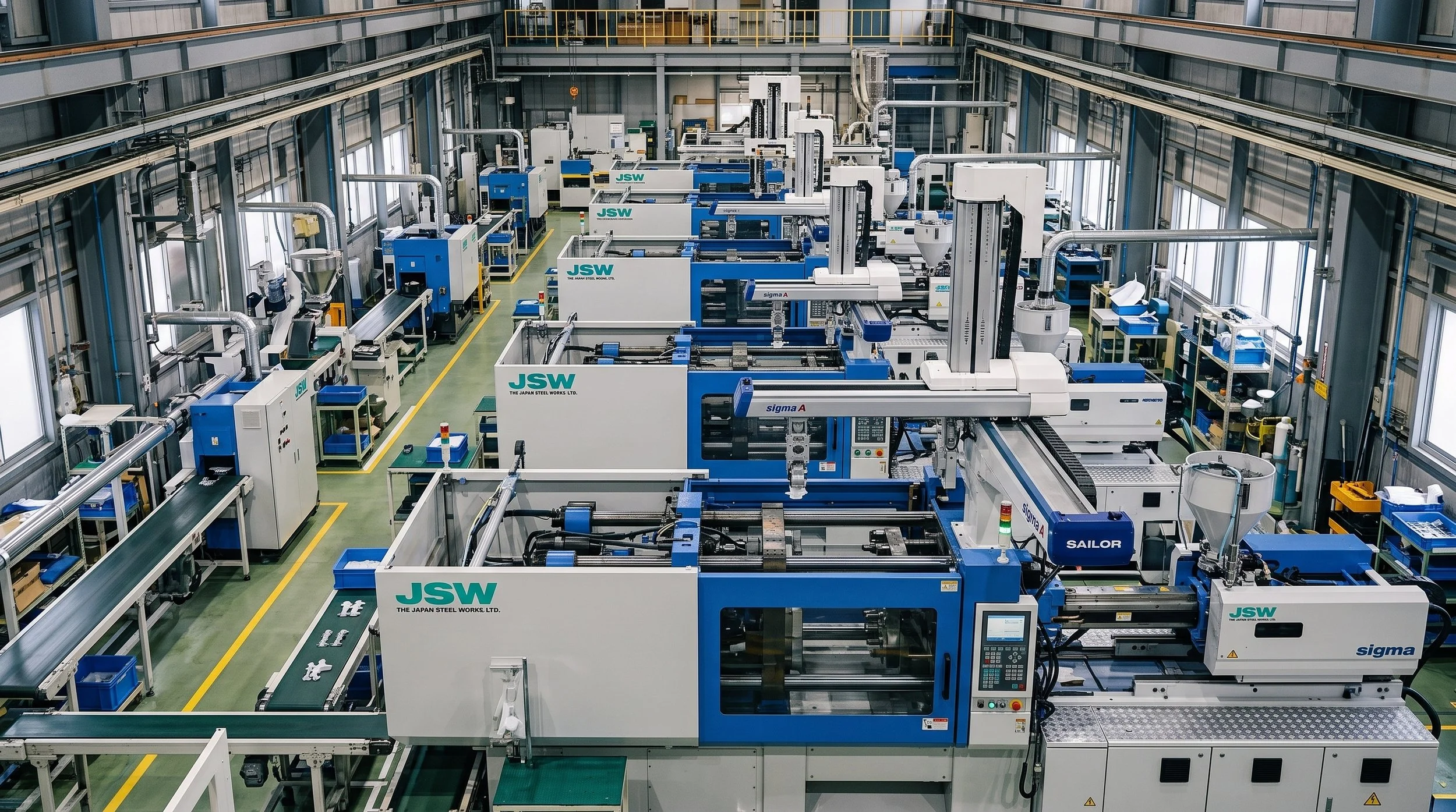
As a supplier of JSW (Japan Steel Works)—and previously acquired brand 'Meiki' now part of the JSW group—we often consult with enterprise-level buyers who require much more than basic technical specifications.
When operating on a global scale, the goal is to future-proof your fleet against fluctuating material qualities, rising energy costs, and catastrophic downtime.
Exploring how Japanese engineering handles these exact challenges helps clarify why this tier of machinery is increasingly the standard for high-volume manufacturing.

Sustainable Injection Molding: Mastering PCR and Eliminating Flash
Major brands face strict Net-Zero targets and mandates to transition to Post-Consumer Recycled (PCR) resins, bio-plastics, and tethered caps. However, recycled materials suffer from notorious melt-flow inconsistencies. On a standard machine, these variations frequently cause spikes in scrap rates, short shots, and flash.
Flash is rarely just an aesthetic issue or a minor nuisance requiring manual trimming. In high-speed packaging, flash physically forces mold halves apart. Over thousands of cycles, this leads to hobbing, crushing of the parting line, and severe wear on multi-million-pound, multi-cavity tools.
A machine that cannot compensate for material variation is actively destroying your most expensive assets.
➤ JSW SYSCOM Control: Real-Time Controller Compensation for PCR
To navigate this, JSW’s advanced SYSCOM control system, combined with their industry-leading servo motors, offers a highly effective approach. This technology allows for real-time injection profiling and dynamic clamping force control. If the melt flow of a recycled batch varies slightly, the JSW controller micro-adjusts the injection pressure and speed within milliseconds, preventing over-packing and eliminating the root cause of tool-damaging flash.
Cutting Energy Costs by 50% to 70% ➤ J-AD All-Electric Servo Architecture
Sustainability Impact: By utilizing JSW’s J-AD (Advanced Direct Drive) all-electric architecture, which relies on independent servo motors that only draw power when moving, facilities typically see their electricity bills—and the associated Scope 1 and 2 emissions—cut by 50% to 70% compared to traditional hydraulic systems.

Industry 4.0 & Lights-Out Molding: Future-Proofing Automated Operations
Whether your facility is aggressively transitioning to a fully automated "lights-out" operation today, or simply laying the digital groundwork to future-proof your factory over the next decade, achieving advanced autonomy requires absolute machine reliability and seamless remote oversight. A plant manager in London and a plant manager in Jakarta need to operate on the exact same standard; relying on isolated machinery means no centralized visibility into predictive maintenance, cycle times, or live efficiency drops when the floor is unstaffed.
➤ J-WiSe Platform: Seamless MES Integration and Remote Monitoring
In our experience deploying JSW machinery, preventing these isolated data silos is heavily reliant on native Euromap 77/82 connectivity and the J-WiSe (JSW Web interaction Service) platform. Because these machines are designed to plug directly into global Manufacturing Execution Systems (MES), CAPEX managers and process engineers can monitor exact predictive maintenance data, trace quality metrics, and oversee production efficiency across the globe in real-time, all without needing a technician physically at the press.
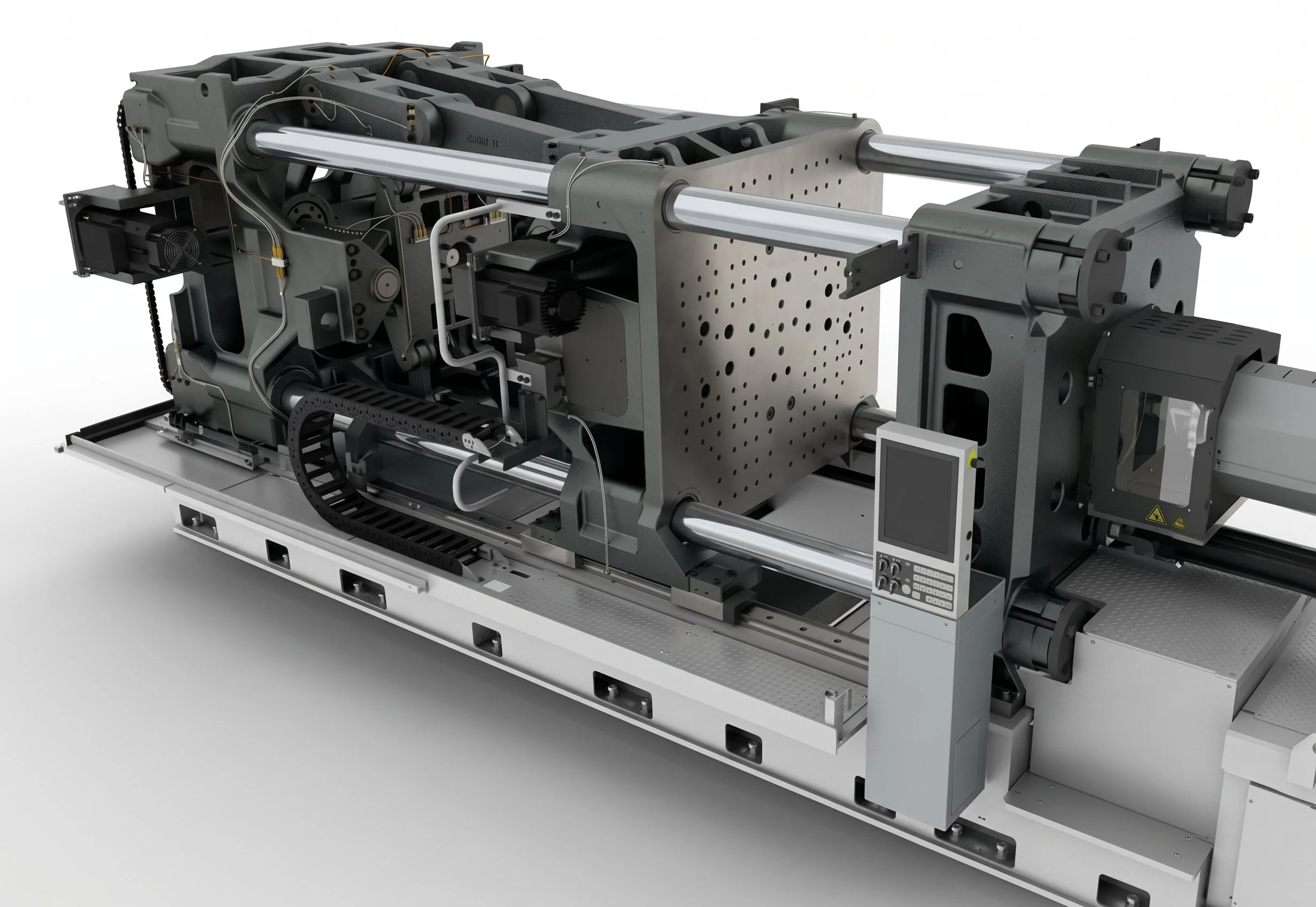
All-Electric Drive Architecture: The Physics of Fast Cycles and True Uptime
In demanding sectors like high-volume packaging, lost efficiency from cleaning, breakages, heavy maintenance, and the wait times for spare parts is a live, ongoing bleed on revenue. The true competitive advantage of Japanese machinery is supreme shot-to-shot repeatability and the ability to "setup and leave" the equipment running continuously.
➤ Decoupled Servo Drive: Simultaneous Motion for Faster Cycle Times
Because JSW all-electric machines decouple every axis (clamping, injection, metering, and ejection) using dedicated servo motors, they provide distinct operational benefits:
Overlapping Fast Cycles: With independent motion, the machine can open the mold, eject the part, and start plasticizing the next shot in the exact same time frame, aggressively driving down cycle times.
Micron-Level Repeatability: Highly rigid clamping systems and robust toggle mechanisms ensure that components are molded with extreme accuracy, preventing the micro-collisions that degrade expensive multi-cavity tools.
Cleanroom Ready: With no hydraulic fluid or oil mist, these all-electric presses drastically lower the cost of maintaining ISO Class 7 or 8 cleanrooms for sensitive or food-grade applications.

Global Machine Support and JSW's Asian Supply Network
Long-term durability is vital to ROI, but at scale, localized issues can still ripple into multi-million-pound supply chain bottlenecks if a machine goes down. Choosing equipment backed by a massive, established Asian manufacturing network ensures you are supported by an incredibly deep supply chain for spare parts.
➤ Localized Regional Engineering: 48-Hour Engineer Attendance
JSW operates an extensive network across Asia with dedicated technical and sales offices spanning Singapore, Thailand, Indonesia, the Philippines, Malaysia, Vietnam, India, China, and Taiwan. Backed by a global workforce of over 5,400 employees, JSW ensures there is a dedicated group of engineers for each region.
This massive footprint translates directly to highly accessible proprietary spares and rapid-response technical teams. It keeps operational risk to an absolute minimum, ensuring that critical replacement parts can mean an engineer is in attendance on your shop floor within 48 hours.

All-Electric Injection Molding ROI: A Cap Closure Case Study
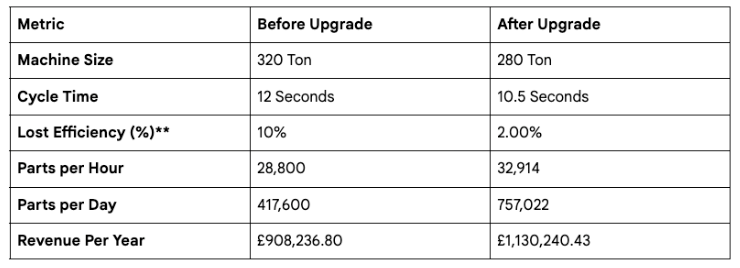
The return on investment for premium machinery becomes highly visible when production output scales and downtime is minimized. As detailed in our client’s packaging case study - molding polypropylene cap closures transitioned their production cell to higher-efficiency machinery to enable part flexibility while keeping production numbers high.
The upgrade yielded a massive +98% benefit in machine uptime, and parts produced were up +81.29%.
By upgrading the technology, the financial and operational metrics shifted dramatically:
The Financial Bottom Line:
Generating an extra £222,003.63 in annual top-line revenue per cell—while cutting machine size, reducing scrap from 10% to 2%, and achieving 50–70% lower power consumption—directly offsets the higher initial CAPEX investment within the first 12–18 months of continuous operation.
**Lost Efficiency here is machine only measured SPC (Statistical Process Control), but other efficiency benefits were captured from reductions in offline activity to increase production (e.g. reduced mold cleaning, breakage, cavity clogging from gas, quicker colour and resin changeover etc)
By dropping the machine tonnage to a highly efficient 280-ton model, shedding 1.5 seconds off the cycle time, and reclaiming 8% of previously lost efficiency, the client significantly increased their revenue without expanding their factory footprint.
When a Premium Japanese Injection Molding Machine Doesn't Make Sense
While the technical advantages are clear, it is equally important to recognize when investing in premium Japanese engineering does not align with your business model. Because these machines command a higher initial CAPEX, the return on investment relies heavily on utilizing their high-end capabilities.
If your operation focuses primarily on very low-volume custom jobs, the fractional cycle-time savings and extreme repeatability won't have the volume needed to compound into meaningful revenue.
Similarly, if you are molding low-precision, thick-walled parts using highly degraded structural plastics where dimensional tolerance is broad, the micron-level precision of a servo-driven all-electric press may be unnecessary.
Finally, for applications requiring massive, sustained raw hydraulic force—where cycle times are long and precision is secondary to brute pressure—a traditional, lower-cost hydraulic machine might make more financial sense.
The "Which Injection Molding Machine is Right for Me?" Framework
Before investing in a new injection molding machine, global procurement and engineering teams should evaluate their production reality against three core questions:
What type of project am I running, and does our corporate ESG mandate require the shift to all-electric technology?
What kinds of production levels am I targeting now, and will I be integrating PCR or complex bio-resins that require advanced controller compensation to protect our tooling?
Do I need the benefit of extreme repeatability, fast overlapping cycles, global MES integration for future automated capabilities, or cleanroom environments?
Upgrading a global manufacturing footprint doesn't happen overnight—and it doesn't require replacing operational machinery. Most Tier-1 producers introduce premium all-electric technology strategically, starting with a single bottlenecked line, a high-scrap PCR application, or an upcoming tooling expansion.
“Schedule a Production Line Benchmark with our engineering team. We’ll analyze your cycle times, scrap rates, and power consumption on your most demanding cell to calculate the exact ROI of introducing JSW technology to your floor.”