

Sailor Full Factory Robotics
Sailor Full Factory Robotics
Robots | Sailor
Developed from their original intricate pen production industry in 1970, Sailor recognised their ejection and assembly teams were loosing time from slow equipment, inconsistent part dimensions at assembly, too many breakdowns, mould damage and expensive material rejects, ultimately, harming their cycle time and bottom line.
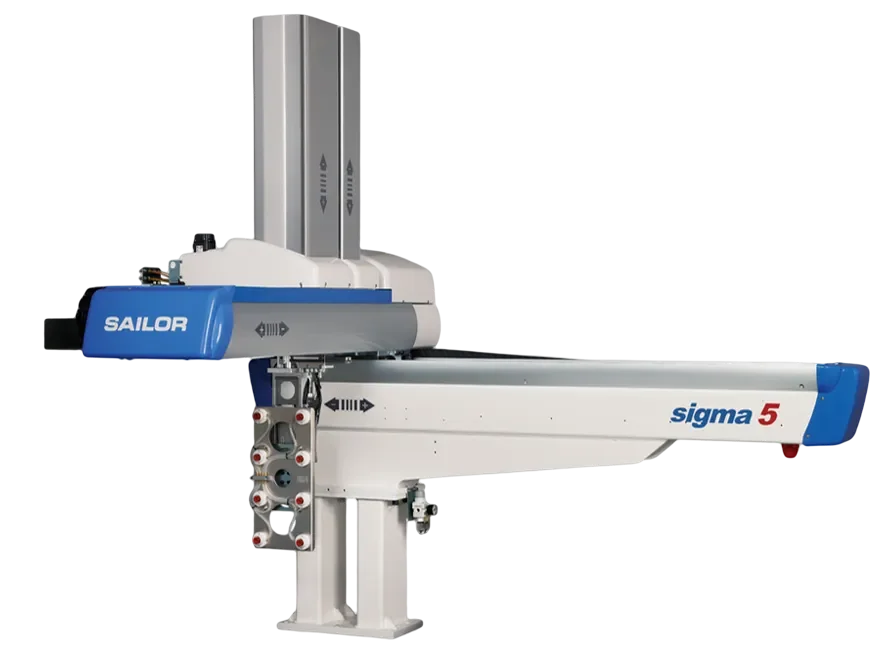
Sailor developed light weight robust robots (including a carbon fibre range) with a unique ‘harmonic curves’ in its stroke as well as a picking a placing conveyor system and automation lines to halve take out time, reduce breakdown to years and keep parts consistent to reduce rejects, often resulting in production lines with double the parts per month compared to standard setups.
Sailor’s robots work with a rack and pinion technology as opposed to traditional belt drives, this removes the need for belt tensioning by increasing stiffness, meaning lightweight robotics can deal with high load capacity and long-travel capability, keeping speed fast to ensure the ability to cope with large levels of inertia (reducing breakdowns).
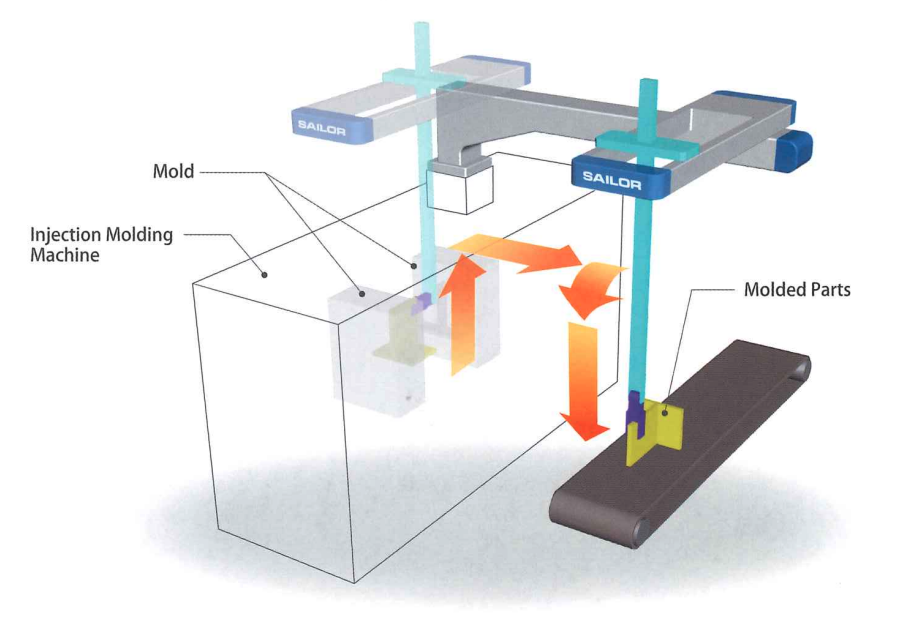
The rack and pinion technology is combined with ‘harmonic curves’ in the robots movements, to eliminate vibration reducing damage at ejection and further increases production speed, by combining 2 movements into one motion (the robots vertical movement also moving forward at the same time and vice-a-versa). The capability halves take out times and eliminates vibration to ensure stable consistent part delivery of even the most delicate products.
As the fast robot continues in the background, their conveyor process works alongside their robots to double speed of production. The robot places hot products on the conveyor system in a controlled manner to ensure they have 5/6 minutes to cool and stabilise before placing into a box.
Failure to do this, such as parts dropping down a chute and straight into a box, means whilst parts are still vulnerable to changes, heat can build up in the box causing distortion and variable part quality, as well as damage can be caused whilst they rattle down the chute. Only at assembly is product distortion recognised with an inability to assemble. Causing teams to spend many lost man hours in deconstruction and reconstruction.
Sailors end-to-end take-out and stocking process allows for rigid, fast and consistent products, without extending cycle times that go for years without breakdowns. Sailor stress the importance of ‘MTBF’ (minimum time between failure) which they measure in years not months. With estimated downtime approximately once in every 5 years.
Industry use: Intricate Medical and Healthcare, Delicate Electronics and Connectors, Cosmetic, Plumbing, Automotive, Packaging, Telecomms.
Fastest delivery time: 6 Weeks